
Human Evolution, the Brain Explosion, the Abrahamic Religions and the Enlightenment
Perhaps a true understanding of our origins can act as a catalyst to unite humanity.

What is called the Brain Explosion began about 150,000 years ago, well before the Abrahamic Religions. Perhaps if people understand that this Brain Explosion includes all of us we can finally get beyond the Abrahamic Religions that have divided us for the past 4000 years. Perhaps a true understanding of our origins can act as a catalyst to unite humanity. Because if we can’t unite the next ten years could bring about a global civil war.
Summary
This is actually an excerpt from one of my earlier essays. But I think it is important because a true understanding of our origins may act as a catalyst to unite humanity. And by uniting humanity perhaps we can better focus on the real enemy: the globalists who are pushing us toward a cashless society where we become nothing more than slaves on a Global Plantation.
Very few understand that the first religion was Animism which goes back 100,000 years Vs the Abrahamic religions that only go back roughly 4,000 years. Very few understand that the “brain explosion,” some 100,000 years ago, defies Darwinian evolution and most probably was the was the prerequisite for religion, music, advanced language capabilities, writing and more advanced societies. It is my hope that this may help us humans remember who we really are and get beyond the antiquated Abrahamic religions.
As we enter the second quarter of the 21st century the globalists have pushed the Great Replacement, to inject millions of Muslims into first world nations, in order to destabilize and divide them. I have written extensively about this in my 440 page series of essays which you can find in my archives: The Urgent Need for Global De-Islamification. I have lived in the Dearborn area all of my life which was once the largest Muslim population in the United States. Up until the slaughter of Israelis by Hamas (10/07/2023), and the subsequent invasion of Gaza, it seemed the Muslims were assimilating well to American culture. Then suddenly the Antisemitism reared its head and it became clear that they really aren’t assimilating at all. Worse yet a nation-wide Red/Green alliance appeared nationally which is even more alarming. I have always liked the Muslim people but it now seemed clear that De-Islamification is now required to pressure Muslim assimilation.
The same trend is playing out globally and the EU nations are demanding the mass deportation of Muslim immigrants. The globalists, like Starmer, have pushed a two-tiered justice system which treats Muslims better than the indigenous populations and the British people have had enough. They have allowed the proliferations of Muslim rape gangs which have now claimed over 250,000 young British women. Meanwhile they are providing free housing for the Muslim immigrants and nothing for the British people. And this is what forced Starmer to step down the other week only to be replaced by another globalist who will surely push the same policies.
Then just the other week the movie ‘Citizen Vigilante’ came out and is being viewed by millions. ‘Citizen Vigilante’ is the surprise hit film about a wealthy American businessman living in Croatia who uses his US military training to go on a killing spree of migrant criminals, rapists and corrupt judges, thus becoming an underground public hero who’s being stalked by Interpol. You can read more about the film and view it for free in the link below.

I may very well be as clueless as Candide.
=====
A young man, Candide, lives a sheltered life in an Edenic paradise, being indoctrinated with Leibnizian optimism by his mentor, Professor Pangloss. This lifestyle is abruptly ended, followed by Candide's slow and painful disillusionment as he witnesses and experiences great hardships in the world.
Candide, Wiki
https://en.wikipedia.org/wiki/Candide
=====
But perhaps if people understand that this Brain Explosion includes all of us we can finally get beyond the Abrahamic Religions that have divided us for the past 4000 years. Perhaps a true understanding of our origins can act as a catalyst to unite humanity. Because if we can’t unite the next ten years could bring about a global civil war.
Human Evolution, the Brain Explosion, the Abrahamic Religions and the Enlightenment
Here is a graphic I drew up to encapsulate human history from our first common ancestor, who lived among the dinosaurs for 20 million years, to the present. Very few understand that the first religion was Animism which goes back 100,000 years Vs the Abrahamic religions that only go back roughly 4,000 years. Very few understand that the “brain explosion,” some 100,000 years ago defies Darwinian evolution.
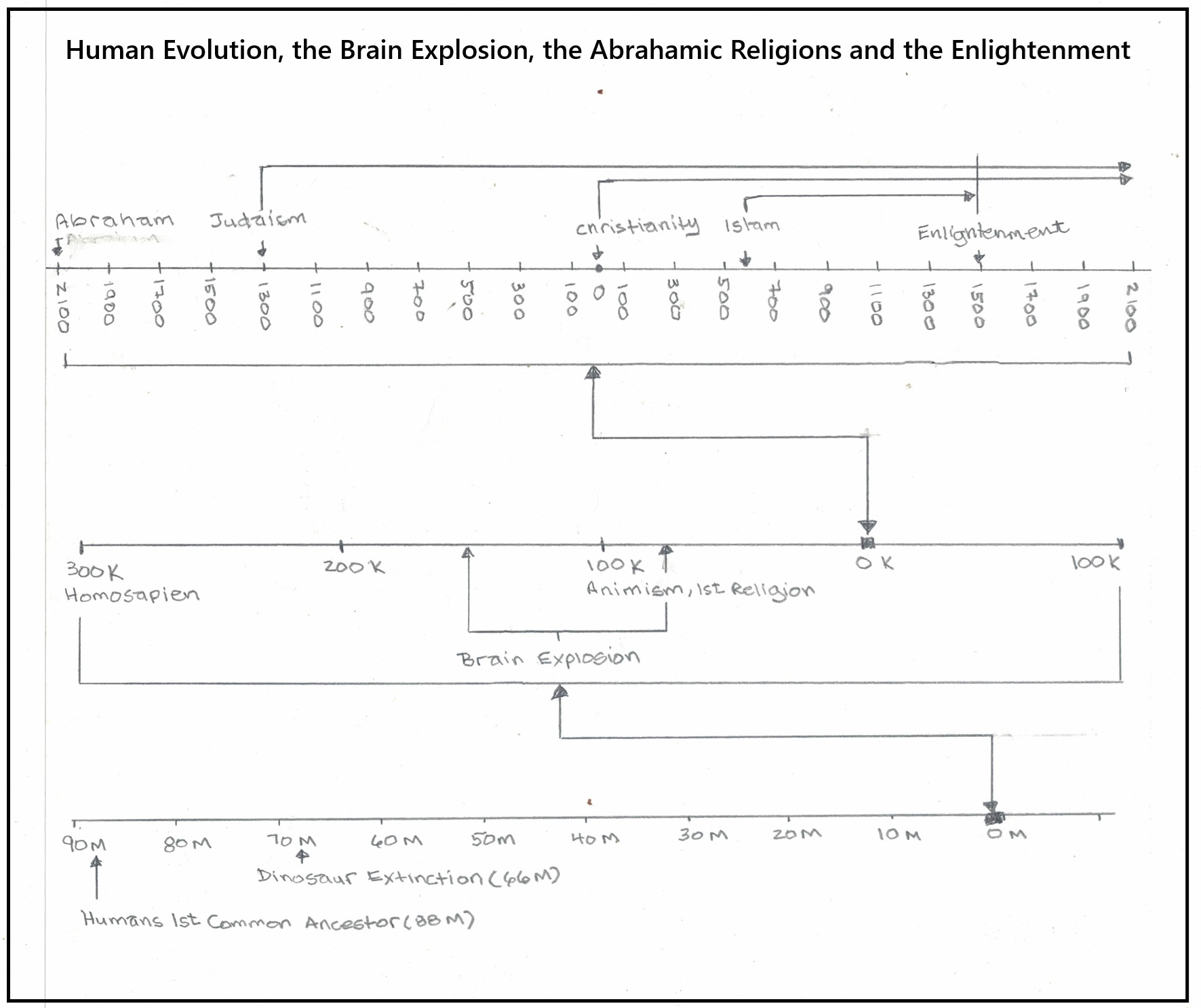
It is only because of the expansion of our collective knowledge, Gnosis, that we understand our place in the Cosmos. The Abrahamic religions long believed that the Earth was the center of the Cosmos, that the Earth was only 6000 years and that it was created by a singular god. They had no idea that we reside in the Milky Way Galaxy composed of billions of solar systems. They had no idea that the Cosmos is composed of trillions of galaxies It is only because of the Enlightenment and the expansion of the sciences that we now know that:
* Our Cosmos may be a part of a Multiverse going back trillions of years.
* Our Cosmos originated with the Big Bang some 13.7 Billion years ago
* Our planet Earth began 4.7 billion years ago
* Our Sun may well implode in the next 2-4 billion years
The Abrahamic religions also had no understanding of human evolution. Through archeology, anthropology and other evolving sciences we now know that our earliest human ancestor, a small-brained version of today’s dwarf lemur, coexisted with the dinosaurs from 88 million years ago until an asteroid decimated the dinosaurs 66 million years ago. They had no clue that us humans, Homo sapiens, go back some 300,000 years.
But then something happened between 150,000 to 70,000 years ago that defies Darwinian evolution, because it happened in the evolutionary wink of an eye. It is often referred to as “The Human Brain Explosion.” During this period there was an exponential rewiring of the brain and an exponential evolution of certain genes, including the FOXP2 gene and mirror neurons which gave us the ability to empathize and think symbolically. These changes quickly led to advanced speech, writing, the first religion and advanced societies. It happened far to fast to be explained by Darwinian evolution.
=====
We already know some basics of human brain evolution. First came the enlargement of the primate brain, culminating perhaps 2 million years ago with the emergence of our genus, Homo, and the use of crude stone tools and fire. Next came a tripling of brain size during the 500,000 years before Homo sapiens arose. Finally, just over 50,000 years ago, there was a great leap forward in human behavior, with archaeological evidence of more efficient manufacturing of stone tools and a rich aesthetic and spiritual life. What transpired genetically? Prior research has taken a piecemeal approach to occasional genes that have different structures in humans versus non-humans. For example, Walsh’s lab has identified several genes that regulate cerebral cortical size and patterning, some of them through the study of brain abnormalities. The lab recently found a gene involved in brain folding—thanks to a brain malformation called polymicrogyria—that may have enhanced our language ability. But such findings only scratch the surface of the cognitive, behavioral and cultural strides humans have made over the past 50,000 years. That’s a blink of the eye in evolutionary terms. What enabled us to invent money, develop agriculture, build factories, write symphonies, tell jokes?
Decoding Brain Evolution (07/06/2027)
New center asks: What genetic changes gave us the human brain?
https://hms.harvard.edu/news/decoding-brain-evolution#
=====
Ancient Aliens (Season 1, Episode 4, “Human Genesis”) goes into the human brain explosion in great depth. The entire episode is not available on YouTube as far as I can tell. Of course they attribute the brain explosion to alien intervention. Alternatively it could be the intervention of cosmic intelligence supported by string theory. It is also possible that the use of plant entheogens had a part in the rewiring of the brain. Of course all of these theories are mere speculation. But something miraculous happened in the evolutionary “blink of an eye.”
=====
Researchers in Chicago come to the conclusion that the sophistical of the human brain isn’t just a result of evolution. See more in this clip from Season 1, Episode 4, “Human Genesis.”
The Brain’s Big Bang: Origins of Consciousness (Season 1) | Ancient Aliens (05/07/2025)
=====
And these exponentially fast changes led to the first religion around 100,000 years ago: Animism.
Animism, the first human religion, the oldest spiritual system
=====
ANIMISM: The Oldest Spiritual Belief in Human History (Explained from A to Z) (04/05/2025)
=====
=====
Yes, many scholars believe animism, the belief that spirits inhabit natural objects and phenomena, is humanity’s oldest spiritual system, potentially emerging tens of thousands of years ago during the Paleolithic era, with roots possibly extending back 100,000 years or more, evidenced by early cave art and burial practices suggesting a world view where everything was alive and communicative. While exact origins are debated, studies of hunter-gatherer societies suggest animism was the earliest religious trait, preceding beliefs in an afterlife or shamanism.
Key Points about Early Animism:
* Deep Roots: Animism predates formal religions, temples, and writing, developing as early humans sought to understand and interact with a world they perceived as full of agency and spirit.
* Evidence in Art & Ritual: Paleolithic cave paintings (like Lascaux) and ritualistic burials are interpreted as communications with the animal spirit world or evidence of beliefs in the afterlife, points to animistic thought.
* Hunter-Gatherer Basis: A study of hunter-gatherers identified animism as the foundational religious trait, with other elements like shamanism and ancestor worship developing later.
* Universal Concept: Animistic ideas, where non-human entities have souls or spirits, have appeared independently across diverse cultures globally and continue in many indigenous traditions.
Why it’s Considered First:
* It reflects a fundamental human tendency to see the world socially, extending personhood beyond humans to animals, plants, and even inanimate objects, a worldview supported by early archaeological finds.
Google AI [first religion animism 100,000 years ago]
=====
Animism, Entheogens and string theory
String Theory basically supersedes Einstein’s Theory of Relativity and, like Animism, sees every particle in the Cosmos connected by what are called strings. When I was a young hippie in high school (c. 1970 - 1972) I did many entheogens -- LSD, Psilocybin, Peyote, Mescaline -- and eventually worked for Hearing Aid where we basically talked people down from “bad trips.” One of the recurrent themes from these psychonauts (entheogen users) was that during their “trips” they felt as if everything was connected.
=====
Astrotheology, the study of cosmic myths in religion, and entheogens, consciousness-altering substances used in spiritual rituals, intersect as ancient cultures linked celestial events (astro) with divine experiences (theology) often facilitated by hallucinogens like mushrooms or peyote, suggesting early humanity used these plants for profound cosmic connection, foresight, and divine communication, themes explored in modern astrotheology’s look at space-mythology links.
Astrotheology
* Definition: Combines astronomy/space science with theology, examining the divine or mythological aspects of the cosmos and space exploration.
* Focus: Finds religious, cultural, and ethical meanings in space, linking ancient myths (like constellations) with modern scientific discoveries, as explored in books like Gods of the New Millennium or theories by Michael S. Brown.
Entheogens
* Definition: Substances (like psilocybin, peyote, ayahuasca) used to induce spiritual or mystical states, meaning “generating the divine within”.
* Historical Use: Widely used by ancient civilizations (Maya, Aztecs, Siberian shamans) in rituals for healing, divination, connecting with deities, and shamanic journeys.
The Intersection: Cosmic Connection
* Ancient Practices: Many ancient cultures used entheogens in ceremonies focused on the sky, stars, and celestial cycles, viewing these plants as keys to understanding the cosmos and communicating with celestial beings or gods.
* Visionary Experiences: Entheogenic journeys often produced vivid, cosmic visions, patterns (like fractals), and encounters with “divine” entities, which could then be mapped onto the night sky, influencing mythology and early astronomical observations.
* Modern Exploration: Contemporary astrotheology and researchers in consciousness (like Graham Hancock, Terence McKenna) suggest these ancient practices were foundational to early religions, where entheogens served as powerful tools for interpreting the universe.
In essence, early humans used entheogens to directly experience the cosmos (astro), fostering deep spiritual beliefs (theology) that shaped their understanding of the universe, a concept explored in modern astrotheology.
Google AI [astrotheology and the use of entheogens]
=====
Animism and string theory
=====
Animism and string theory, while originating from vastly different frameworks—one a deeply rooted, indigenous, or spiritual worldview, and the other a cutting-edge, mathematical, theoretical physics framework—find a conceptual bridge in the idea that the universe is composed of active, interconnected, and vibrating energy.
Conceptual Parallels
* Vibrating Energy: String theory proposes that the fundamental constituents of the universe are not points, but rather tiny, one-dimensional, vibrating strings of energy. Animism, in a modern, metaphysical interpretation, posits that all matter—including rocks, water, and trees—is animated by, or composed of, living forces or spirits.
* Fundamental Interconnectedness: String theory suggests a deeply interconnected universe, often discussed in terms of particles being different vibrations of the same fundamental strings. Similarly, animism views the world as a web of relationships, where every entity is in direct, often spiritual, interaction with its surroundings.
* The “Living” Universe: String theory describes a universe that acts as a symphony of vibrating strings. This can be interpreted in an animistic sense, where the “music” or “dance” of these strings gives rise to the “mindedness” or agency found in all things.
Differences in Approach
* Methodology: String theory is based on complex mathematical formulas, attempting to unify quantum mechanics and gravity, yet it lacks direct empirical evidence. Animism is a, sometimes ancient, intuitive or, in some contexts, philosophical understanding of the world as fundamentally “alive” or sentient.
* Interpretation of “Spirit”: Animism directly attributes “spirit” or “soul” to natural objects. String theory describes “energy” and “vibrational modes,” which are, for some, a metaphorical or philosophical equivalent to the “spirits” of traditional animism.
* Scope: While some interpretations of string theory suggest a 10- or 11-dimensional universe, including a “landscape” of possible universes, animism often focuses on the immediate, felt, and relational world.
The Intersection in Modern Thought
* “Animistic Physics”: Some thinkers describe modern quantum physics, including string theory, as a form of “animistic physics,” where the distinction between “living” and “inanimate” matter dissolves, as all things are seen to be in motion, connected, and possessing “agency” or energy.
* Panpsychism: The idea that all matter has some form of mind or consciousness, a concept closely linked to some interpretations of animism, finds a, sometimes debated, home in modern discussions of the nature of reality.
In summary, the connection between animism and string theory is not one of direct scientific proof, but rather a compelling parallel where modern physics, in its search for the fundamental nature of reality, has arrived at a picture of a vibrating, interconnected universe that resonates with the ancient, animistic belief in a world filled with living, active, and, at its core, “spirited” entities.
Google AI [animism and string theory]
=====
In essence, animism represents humanity’s earliest way of perceiving and relating to the world as a living, spiritual entity, making it a strong candidate for the first form of human religion, with evidence pointing to its presence well over 100,000 years ago.
A brief history of human religion/spirituality: from Animism to the Abrahamic Religions
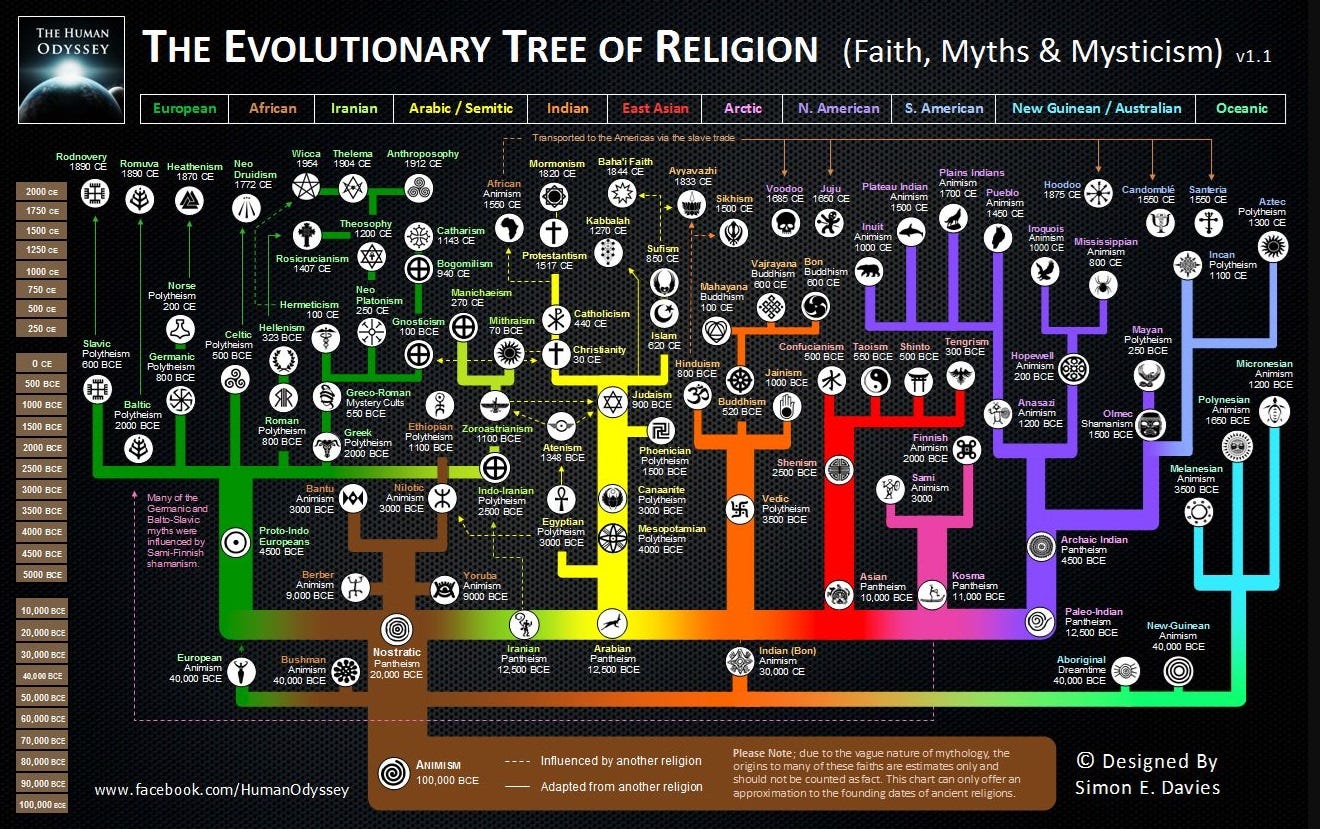
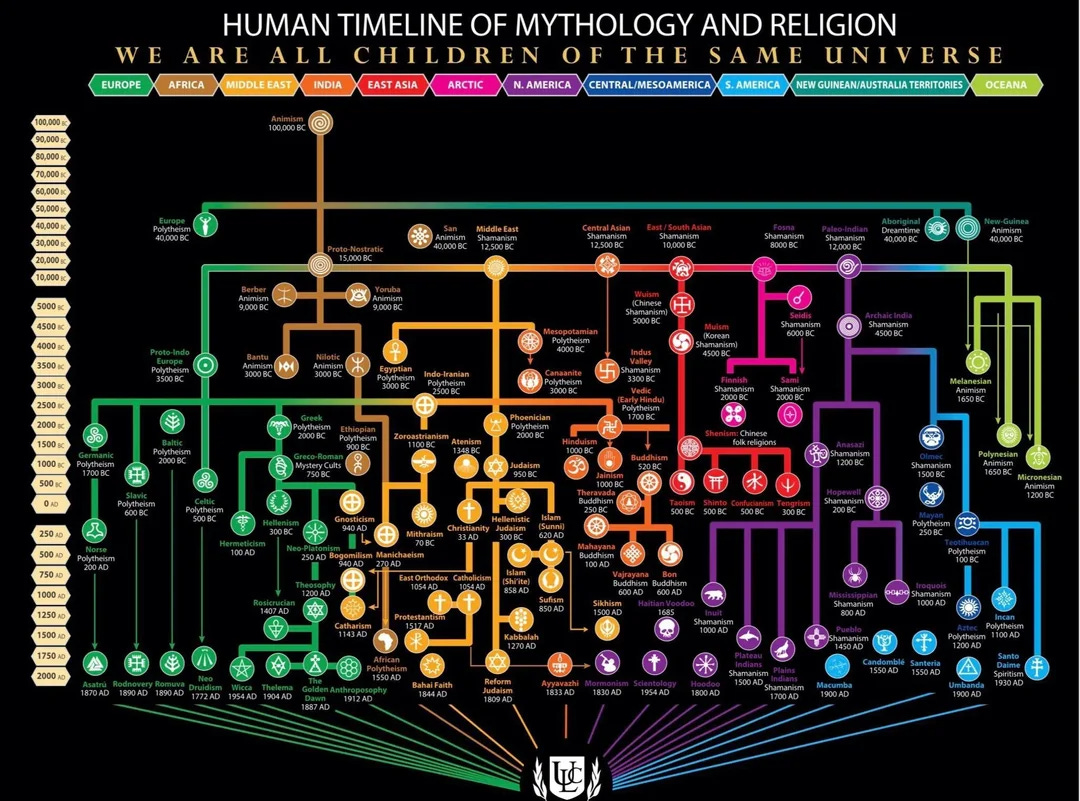
The evolution of human religions goes back to Animism at least 100,000 years ago. The following graphs and videos trace this evolution from Animism to the Abrahamic Religions. I have left out the Mystical Traditions -- such as Yoga, Buddhism, Tao etc. -- that, unlike the literalist religions, believed in a direct connection between man and god. The graphics and videos were produced by Simon Davies and depict how all religions basically go back to the first religion: Animism. I hope you find this as fascinating as I do.
=====
Simon Davies and I look at his Great Tree of Religion, which documents over 500 religions and how they are connected. This was a fascinating discussion and the first ever livestream, and you all were amazing. Thankyou!
The Great Tree of Religion with Simon E Davies (06/23/2024)
=====
=====
Our Stone Age ancestors left Africa around 90,000 years ago, carrying with them the seeds of a spiritual awakening known as the mortuary ritual. As they migrated east towards Asia and Australia, this belief system evolved, leading to an early expression of animism in Asia and establishing the Dreaming in Australia, one of the oldest surviving traditions still with us today.
Out of Africa: The First Wave of Religion (08/31/2024)
=====
The Enlightenment Vs Islam
As the following article states “The central doctrines of the Enlightenment were individual liberty, representative government, the rule of law, and religious freedom, in contrast to an absolute monarchy or single party state and the religious persecution of faiths other than those formally established and often controlled outright by the State. I would encourage reading the entire Wiki article. My primary point is that Judaism and Christianity went through the Enlightenment and came out the other side less violent and more tolerant. It is only Islam that continues to push for a Theocratic Global Caliphate and the medieval barbarism that goes with it. There are no longer any Christian or Judaic theocracies. During the evolution of the Abrahamic religions they tried to convince the masses that “god” was always watching them as a means of social control. They all insisted that their “church or mosque” would remain an intermediary between the individual and god. And they crucified the Gnostics, and similar religious ideologies, because they believed in a direct relationship between man an god. Such heretical thoughts were seen as threat to their social control. Today, because of the 4th Industrial Revolution, we are entering a period where a centralized technocratic control grid, could soon scrutinize everything we do and everywhere we go. And if we don’t submit our digital wallets will be suspended and our livelihoods will be destroyed. In a sense you could argue we are building a Digital God, centrally controlled by Elite Global Psychopaths. If we want to preserve individual liberties for future generations then both Islamic Theocracies and a Technocratic Slavery must be neutralized.
=====
The Age of Enlightenment (also the Age of Reason) was a period in the history of Europe and Western civilization[1] during which the Enlightenment,[b] an intellectual[6] and cultural[6] movement, flourished, emerging in the late 17th century[6] in Western Europe[7] and reaching its peak in the 18th century, as its ideas spread more widely across Europe[7] and into the European colonies, in the Americas and Oceania.[8][9][10] Characterized by an emphasis on reason, empirical evidence, and scientific method, the Enlightenment promoted ideals of individual liberty, religious tolerance, progress, and natural rights. Its thinkers advocated for constitutional government, the separation of church and state, and the application of rational principles to social and political reform.[11][12][13]
The Enlightenment emerged from and built upon the Scientific Revolution of the 16th and 17th centuries, which had established new methods of empirical inquiry through the work of figures such as Galileo Galilei, Johannes Kepler, Francis Bacon, Pierre Gassendi, Christiaan Huygens and Isaac Newton. Philosophical foundations were laid by thinkers including René Descartes, Thomas Hobbes, Baruch Spinoza, and John Locke, whose ideas about reason, natural rights, and empirical knowledge became central to Enlightenment thought. The dating of the period of the beginning of the Enlightenment can be attributed to the publication of Descartes’ Discourse on the Method in 1637, with his method of systematically disbelieving everything unless there was a well-founded reason for accepting it, and featuring his dictum, Cogito, ergo sum (’I think, therefore I am’). Others cite the publication of Newton’s Principia Mathematica (1687) as the culmination of the Scientific Revolution and the beginning of the Enlightenment.[14][15][16] European historians traditionally dated its beginning with the death of Louis XIV of France in 1715 and its end with the outbreak of the French Revolution in 1789. Many historians now date the end of the Enlightenment as the start of the 19th century, with the latest proposed year being the death of Immanuel Kant in 1804.[17]
The movement was characterized by the widespread circulation of ideas through new institutions: scientific academies, literary salons, coffeehouses, Masonic lodges, and an expanding print culture of books, journals, and pamphlets. The ideas of the Enlightenment undermined the authority of the monarchy and religious officials and paved the way for the political revolutions of the 18th and 19th centuries. A variety of 19th-century movements, including liberalism, socialism,[18] and neoclassicism, trace their intellectual heritage to the Enlightenment.[19] The Enlightenment was marked by an increasing awareness of the relationship between the mind and the everyday media of the world,[20] and by an emphasis on the scientific method and reductionism, along with increased questioning of religious dogma—an attitude captured by Kant’s essay Answering the Question: What Is Enlightenment?, where the phrase sapere aude (’dare to know’) can be found.[21]
The central doctrines of the Enlightenment were individual liberty, representative government, the rule of law, and religious freedom, in contrast to an absolute monarchy or single party state and the religious persecution of faiths other than those formally established and often controlled outright by the State. By contrast, other intellectual currents included arguments in favour of anti-Christianity, Deism and Atheism, accompanied by demands for secular states, bans on religious education, suppression of monasteries, the suppression of the Jesuits, and the expulsion of religious orders. The Enlightenment also faced contemporary criticism, later termed the “Counter-Enlightenment” by Sir Isaiah Berlin, which defended traditional religious and political authorities against rationalist critique.
Age of Enlightenment, Wiki
https://en.wikipedia.org/wiki/Age_of_Enlightenment
=====
Of the three Abrahamic religions Christianity and Judaism have reformed significantly since the Enlightenment (c. 1500 - 1800). It is only Islam that continues to push for a Global Caliphate and the medieval barbarism that often goes with it.
=====
One of the central tenets of science is to define a problem to be studied with as much clarity as possible, and the key to clear communication is calling things what they really are. Unfortunately, both the American media and public intellectuals have failed to be honest in identifying what everyone in Europe knows is the primary source of terrorism in the world today: Islam.
Yes, there are political and economic motives behind terrorism in addition to religion, and most Muslims are not terrorists, particularly those living in Western countries. And of course Islam is not the only religion that can lead to violence, as witnessed in the occasional abortion clinic bombing by Christians, but I can’t even remember when the last one was. (I just checked: there were two in 2012, no injuries, three in 2007, also no injuries, a handful of inept attempts at arson in the early 2000s, with most serious attacks made in the 1980s and early 1990s.) Instead, most Christians who oppose abortion protest peacefully, as they did in front of the Supreme Court building in Washington DC that I happened upon on January 22, the 40th anniversary of Roe v. Wade, when I was in town on my book tour for The Moral Arc.
By contrast, a news cycle does not go by without a report of Islamic terrorists blowing themselves to smithereens, igniting car bombs and IEDs, shooting or stabbing so-called infidels and heretics, and cutting off the heads of or burning alive journalists and other innocents who happened to be in the wrong place at the wrong time. How common are these attacks? According to a preliminary report issued by scientists at the University of Maryland at College Park working at the National Consortium for the Study of Terrorism and Responses to Terrorism, Islamist terrorists stand out far above domestic terrorists on both the Far Left and the Far right. Utilizing data from the Global Terrorism Database, which has accumulated information on over 125,000 terrorist attacks from 1970-2013, including 58,000 bombings, 15,000 assassinations, and 6,000 kidnappings, researchers have been able to more carefully identify what the problem is, starting with a clear definition of terrorism: “The threatened or actual use of illegal force and violence by a non-state actor to attain a political, economic, religious, or social goal through fear, coercion, or intimidation.” Their focus is on terrorism in the United States. Here are a few of their preliminary findings.
Waves of terrorist violence have flared up over the decades. Far Left violent extremists were most active in the late 1960s to early 1970s. Far Right terrorists were most active in the 1990s. And since 9/11 most terrorists are Islamist extremists.
Far Right and Far Left extremists tend to be loners and individuals with psychological problems, whereas “Islamist extremists tended to be part of tight-knit groups.” All three groups experienced similar rates of radicalization in prison.
Additional risk factors for all three groups included relationships with other extremists and romantic relationship troubles, but “only far right extremists had extensive previous criminal backgrounds.”
Violent Islamist terrorists tended to be young (between 18 and 28 years old), unmarried, and not well integrated into American society.
Most tellingly (for my point here) is that for both Far Right and Far left extremists, “religious activities and beliefs were negatively correlated with the use of violence,” whereas for Islamist terrorists, almost by definition, religion was the primary motive (why else would they be so labeled—the motive is right there in the name “Islamist”).
This graph, generated from the Global Terrorism Database by typing in the keyword “Islam” found a total of 5,704 terrorist incidents, the vast majority in the last couple of years, thereby confirming our intuitions that the trend lines match the headlines.
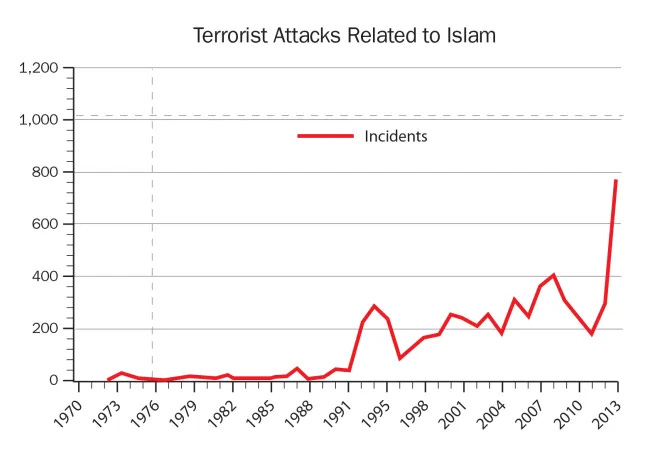
Additional data illuminates why violence may be inherent in the Islamic religion, to the extent that Muslims believe in sharia, especially the parts of the law that command corporal punishment for minor crimes, stoning for adultery, and capital punishment for leaving the Islamic faith. A 2013 Pew poll found these disturbing percentages of Muslims who believe that anyone who leaves Islam should be executed: South Asia (76%), Middle East-North Africa (56%, Southeast Asia (27%, Central Asia (16%), and Southern-Eastern Europe (13%). Why do they believe this? One reason is that most Muslims believe sharia is the revealed word of God: Pakistan (88%), Afghanistan (81%), Palestinian territory (76%, Egypt (70%), Malaysia (66%), Jordan (57%), Iraq (56%), Kyrgyzstan (54%), Lebanon (50%), Bangladesh (50%), Tunisia (44%), Albania (43%), and Russia (39%).
A 2009 Pew study found these percentages of Muslims who say suicide attacks against civilians in defense of Islam are justified: 43% of Nigerian Muslims, 38% of Lebanese Muslims, 15% of Egyptian Muslims, 13% of Indonesian Muslims, and 12% of Jordanian Muslims. A 2006 study found that nearly a quarter of British Muslims believe that the 7/7 terrorist attacks on London in 2005 were justified, and 28% said they hoped that one day the U.K. would become a fundamentalist Islamic state.
So when the Islamic terrorists who murdered the editors and cartoonists at Charlie Hebdo shouted “Allahu Akbar” and proclaimed their acts to be revenge for insulting the prophet Muhammad, we should take them at their word that their religion is what motivated them.
But why is Islam caught up in this cycle of violence and not one of the other two great monotheistic religions, Judaism and Christianity. It was not always so. In the book of Numbers, 31:7–12, for example, Moses assembled an army of 12,000 troops to defeat the Midianites, who were allied with the Moabites in their desire to see the Israelites wiped off the face of the earth.
They warred against Mid′ian, as the Lord commanded Moses, and slew every male. They slew the kings of Mid′ian … And the people of Israel took captive the women of Mid′ian and their little ones; and they took as booty all their cattle, their flocks, and all their goods. All their cities in the places where they dwelt, and all their encampments, they burned with fire, and took all the spoil and all the booty, both of man and of beast. Then they brought the captives and the booty and the spoil to Moses.
That sounds like a good days pillaging, but when the troops got back, Moses was furious. “What do you mean you didn’t kill the women?” he asked, exasperated, since it was apparently the women who had enticed the Israelites to be unfaithful with another God. Moses then ordered them to kill all the women who had slept with a man, and the boys. “But save for yourselves every girl who has never slept with a man,” he commanded, predictably, at which point one can imagine the thirty-two thousand virgins who’d been taken captive rolling their eyes and saying, “Oh, God told you to do that, did he? Right.” Was the instruction to “keep the virgins for yourselves” what God had in mind by the word “love” in the “love thy neighbor” command? I think not. Of course, the Israelites knew exactly what God meant (this is the advantage of writing scripture yourself—you get to say what God meant) and they acted accordingly, fighting for the survival of their people. With a vengeance.
Worse, the book considered by over two billion people to be the greatest moral guide ever produced recommends the death penalty for saying the Lord’s name at the wrong moment or in the wrong context, for imaginary crimes like witchcraft, for commonplace sexual relations (adultery, fornication, homosexuality), and for not resting on the Sabbath. How many of today’s Jews and Christians agree with their own holy book on the application of capital punishment? I dare say it is close to zero. That is how far the moral arc has bent in four millennia.
The reason, I argue in The Moral Arc, is the Judaism and Christianity went through the Enlightenment and came out the other side less violent and more tolerant. Ever since the Enlightenment the study of morality has shifted from considering moral principles as based on God-given, Divinely-inspired, Holy book-derived, Authority-dictated precepts from the top down, to bottom-up individual-considered, reason-based, rationality-constructed, science-grounded propositions in which one is expected to have reasons for one’s moral actions, especially reasons that consider the other person affected by the moral act.
The Enlightenment secular values that we hold dear today—equal treatment under the law, equal opportunity for all, freedom of speech, freedom of the press, civil rights and civil liberties for everyone, the equality of women and minorities, and especially the separation of church and state and the freedom to practice any religion or no religion at all—were inculcated into the minds of Jews and Christians (and others) in the West, but not so much in Muslim countries, particularly those who would prefer a return to the medieval barbarism of theocracies. Until we can take an honest look at the problem and stop accusing people of “Islamophobia” who are courageous enough to say what almost everyone else is thinking, the problem will not go away on its own.
Why Islam? Of the three great monotheistic religions only Islam did not go through the Enlightenment(2015)
https://moralarc.org/why-islam-of-the-three-great-monotheistic-religions-one-did-not-go-through-enlightenment/
=====
A short history of theocratic Islam
The following graph depicts the rise and fall of Islam since it’s inception in 620 AD under Muhammad.
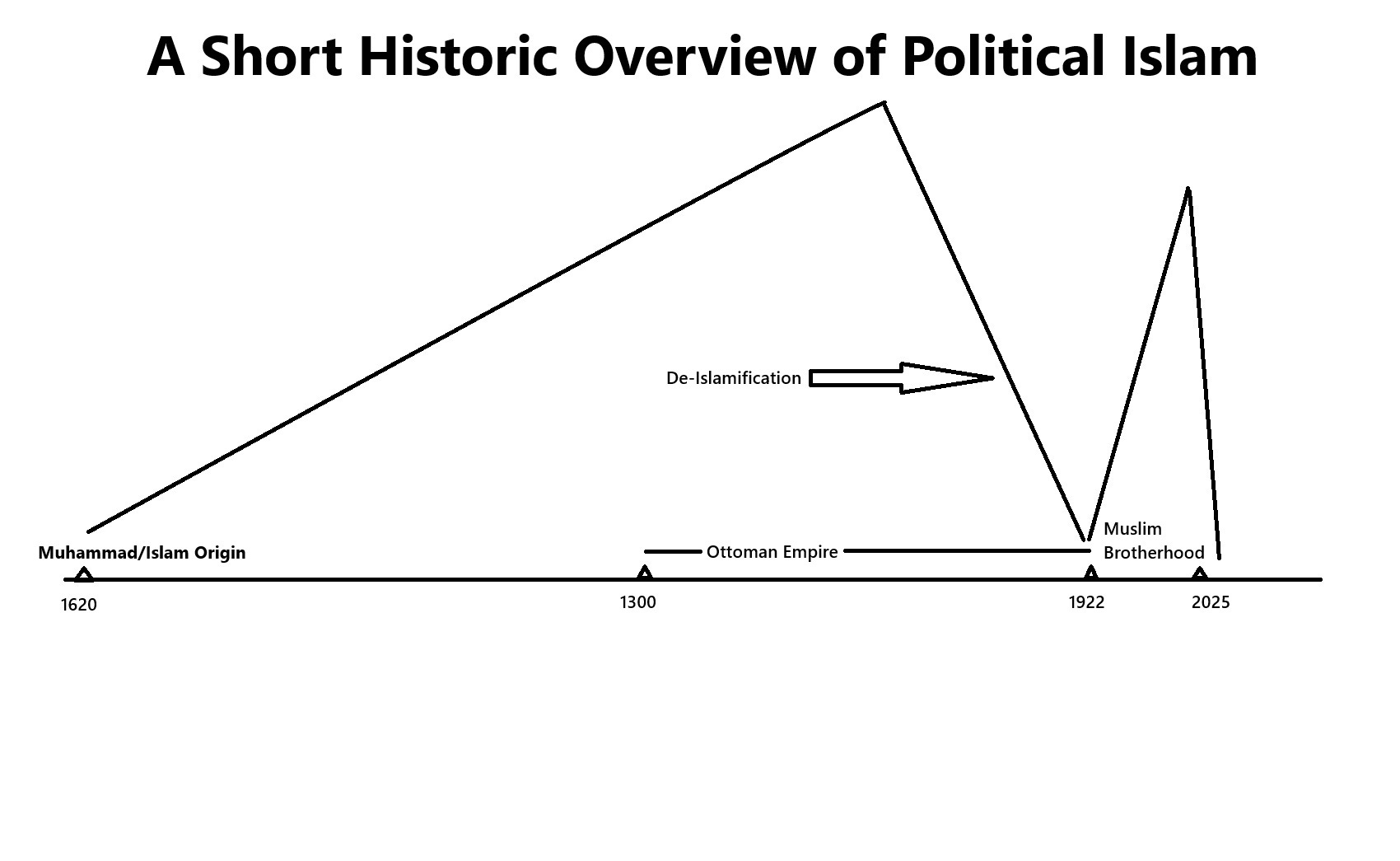
Muslim expansion continued under the Ottoman Empire from 1300 until 1922. In the aftermath of World War I, the victorious Allied Powers occupied and partitioned the Ottoman Empire, which lost its southern territories to the United Kingdom and France. The successful Turkish War of Independence, led by Mustafa Kemal Atatürk against the occupying Allies, led to the emergence of the Republic of Turkey and the abolition of the sultanate in 1922. So basically the first Global De-Islamification was secured in 1922.
Then in 1928 Hassan al-Banna formed the Muslim Brotherhood which sought to continue to push for a Global Islamic Caliphate. And for the next 100 years the Muslim Brotherhood continued its expansion throughout the world. To better understand this I would highly recommend exploring the Wiki articles on Muhammed, the Ottoman Empire and the Muslim Brotherhood. I show the graph line going down at the far right of the graph. That is to show what I hope will be the next Global De-Islamification and the final end of Islam as a political force in the world. It will be up to all of us to insure that happens.
=====
Muhammad, wiki
https://en.wikipedia.org/wiki/Muhammad
=====
=====
The Ottoman Empire,[l] also known as the Turkish Empire,[n] controlled much of Southeast Europe, West Asia, and North Africa from the 14th century to the early 20th century. It also controlled parts of southeastern Central Europe between the early 16th and early 18th centuries.[27][28][29]
The empire emerged from a beylik, or principality, founded in northwestern Anatolia in c. 1299 by the Turkoman tribal leader Osman I. His successors conquered much of Anatolia and expanded into the Balkans by the mid-14th century, transforming their petty kingdom into a transcontinental empire. The Ottomans ended the Byzantine Empire with the conquest of Constantinople in 1453 by Mehmed II. With its capital at Constantinople and control over a significant portion of the Mediterranean Basin, the Ottoman Empire was at the centre of interactions between the Middle East and Europe for six centuries. Ruling over so many peoples, the empire granted varying levels of autonomy to its many confessional communities, or millets, to manage their own affairs per Islamic law. During the reigns of Selim I and Suleiman the Magnificent in the 16th century, the Ottoman Empire became a global power.[30]
While the Ottoman Empire was once thought to have entered a period of decline after the death of Suleiman the Magnificent, modern academic consensus posits that the empire continued to maintain a flexible and strong economy, society and military into much of the 18th century. The Ottomans suffered military defeats in the late 18th and early 19th centuries, culminating in the loss of territory. With rising nationalism, a number of new states emerged in the Balkans. Following Tanzimat reforms over the course of the 19th century, the Ottoman state became more powerful and organized internally. In the 1876 revolution, the Ottoman Empire attempted constitutional monarchy, before reverting to a royalist dictatorship under Abdul Hamid II, following the Great Eastern Crisis.
Over the course of the late 19th century, Ottoman intellectuals known as Young Turks sought to liberalize and rationalize society and politics along Western lines, culminating in the Young Turk Revolution of 1908 led by the Committee of Union and Progress (CUP), which reestablished a constitutional monarchy. However, following the disastrous Balkan Wars, the CUP became increasingly radicalized and nationalistic, leading a coup d’état in 1913 that established a dictatorship.
In the 19th and early 20th centuries, persecution of Muslims during the Ottoman contraction and in the Russian Empire resulted in large-scale loss of life and mass migration into modern-day Turkey from the Balkans, Caucasus, and Crimea.[31] The CUP joined World War I on the side of the Central Powers. It struggled with internal dissent, especially the Arab Revolt, and engaged in genocide against Armenians, Assyrians, and Greeks. In the aftermath of World War I, the victorious Allied Powers occupied and partitioned the Ottoman Empire, which lost its southern territories to the United Kingdom and France. The successful Turkish War of Independence, led by Mustafa Kemal Atatürk against the occupying Allies, led to the emergence of the Republic of Turkey and the abolition of the sultanate in 1922.
Ottoman Empire, wiki
https://en.wikipedia.org/wiki/Ottoman_Empire
=====
Eradicating the Muslim Brotherhood: the head of the Unenlightened Jihadist Snake
There are literally dozens of organizations in the United States and Europe that are associated with the Muslim Brotherhood. The ultimate goal of the Muslim Brotherhood, as articulated by its founder Hassan al-Banna and subsequent leaders, is to create a global, unified Islamic state (caliphate) governed by Sharia law, where Islam is the supreme authority in all aspects of life. Of course Sharia law is absolutely antithetical to our US Constitution and Bill of Rights. Sharia law treats women, non-Muslims etc. as inferior and imposes barbaric punishment that the US would never support. As such all Muslim Brotherhood organizations, and Mosques that promote Sharia law, should be treated as terrorists and treated accordingly. Sharia has no legitimate place in the Post Enlightened 21st Century both in the United States and throughout the planet.
“The ultimate goal of the Muslim Brotherhood, as articulated by its founder Hassan al-Banna and subsequent leaders, is to create a global, unified Islamic state (caliphate) governed by Sharia law, where Islam is the supreme authority in all aspects of life.”
=====
The ultimate goal of the Muslim Brotherhood, as articulated by its founder Hassan al-Banna and subsequent leaders, is to create a global, unified Islamic state (caliphate) governed by Sharia law, where Islam is the supreme authority in all aspects of life. The organization aims to achieve this through a bottom-up approach that starts with reforming individuals, establishing a “Muslim home,” and eventually influencing society and government.
Key aspects of the Muslim Brotherhood’s goals include:
* Establishment of a Caliphate: The long-term, often implicit goal is to unite Muslim-majority lands under a single, supreme authority.
* Implementation of Sharia Law: The group seeks to make the Qur’an and Sunnah the sole, binding constitution for state and society.
* Reclaiming “True” Islam: The Brotherhood aims to eliminate Western influence in the Muslim world, which they argue has corrupted Islamic society.
* “Islam is the Solution”: This foundational slogan emphasizes that the group views Islam not just as a faith, but as a complete system managing politics, economy, and social life.
* Global Reach and Influence: While originating in Egypt, the movement operates globally, aiming to strengthen its influence in both the Middle East and the West.
Methods and Strategies:
* Grassroots Islamization (Dawa): The Brotherhood historically focused on charity, education, and healthcare to gain popular support and influence society.
* Political Engagement: While banned in some countries, the group often seeks to participate in electoral politics to influence legislation and government.
* “Civilization Jihad”: Critics and some investigations describe the group’s strategy in the West as a form of non-violent, structural subversion—a “civilization jihad” aimed at strengthening Muslim communities and influencing policy through lobbying and educational efforts.
Evolution and Divergence:
While officially renouncing violence in the 1970s and focusing on peaceful, political opposition, the Brotherhood has faced significant, sometimes violent, crackdowns in Egypt and elsewhere. Some offshoots, such as Hamas, continue to use violent methods. The organization is often described as a “network of networks” that adapts to local conditions in different countries, leading to variations in strategy.
Google AI [what are the ultimate goals of the Muslim brotherhood]
=====
Here is a partial list of groups in the united states associated with the Muslim Brotherhood.
=====
In the U.S., groups identified as connected to the Muslim Brotherhood network, often through origins or ideology, include the Islamic Society of North America (ISNA), the Muslim American Society (MAS), and the Council on American-Islamic Relations (CAIR), with think tanks and advocacy groups also noted for promoting similar narratives, though CAIR denies links to the Brotherhood. While the Brotherhood itself isn’t federally banned in the U.S., its associated networks are accused of fostering influence, fundraising for groups like Hamas, and coordinating a broader Islamist agenda, prompting some state-level actions and ongoing debate.
Key Organizations Mentioned:
* Islamic Society of North America (ISNA): Described as part of the U.S. Brotherhood network, involved in broader Muslim community activities.
* Muslim American Society (MAS): Also linked to the network and seen as promoting Brotherhood goals.
* Council on American-Islamic Relations (CAIR): A prominent civil rights group that denies any ties to the Brotherhood, despite criticisms and state-level actions.
Other Related Entities & Concepts:
* Interlocking Networks: Groups like the North American Islamic Trust (NAIT) and International Institute of Islamic Thought (IIIT) are part of this ecosystem, as noted in internal documents.
* Ideological Fronts: Organizations promoting Egyptian-American dialogue and advocacy also push Brotherhood-aligned narratives, according to research.
* Financial Links: The Brotherhood’s U.S. network has been implicated in fundraising for Hamas, with entities like the now-defunct Holy Land Foundation (HLF) convicted for supporting terrorism.
Context & Controversy:
* Federal vs. State Action: The U.S. government has designated foreign Brotherhood branches as terrorist entities (e.g., Egyptian & Jordanian chapters) but has not federally designated U.S. groups like CAIR, though states like Texas have taken action.
* “Peaceful Façade”: Critics argue these U.S. groups maintain a public image of civil rights advocacy while advancing the Brotherhood’s broader, extremist agenda, a claim these groups strongly dispute.
Google AI [groups in the united states associated with the Muslim Brotherhood]
=====
And here is a list of groups and nations supporting a global Muslim caliphate, just as the Muslim Brotherhood does in both the United States and other First World nations.
=====
Groups like the Islamic State (ISIL/ISIS) and ideological movements such as Hizb ut-Tahrir explicitly advocate for a global caliphate, while some states like Turkey and Qatar have been cited as supporting Islamist groups (like the Muslim Brotherhood) with similar ambitions, though their direct support for a unified global caliphate is debated. Historically, various caliphates (like the Umayyad, Abbasid, Fatimid) ruled vast Muslim empires, inspiring modern revivals, but currently, no major nation officially supports a single global caliphate, with most supporters being non-state actors or fringe political movements.
Key Groups & Ideologies Supporting a Caliphate:
* Islamic State (ISIL/ISIS): Explicitly aims to re-establish a global caliphate through violence and territorial conquest, though its control has been largely dismantled.
* Hizb ut-Tahrir (HT): A transnational political organization seeking to unify the Muslim world under a single Islamic caliphate through non-violent means, viewing historical Muslim lands (including parts of Europe, India, Russia) as part of it.
* Muslim Brotherhood (MB): While not solely focused on a caliphate, its Islamist ideology promotes a unified Islamic society and governance, with Qatar and Turkey providing significant support to its affiliates.
Nations & State Actors (Indirect or Ambiguous Support):
* Turkey (AKP government): Has provided political and material support to Islamist groups, including the Muslim Brotherhood, aligning with broader Islamist agendas, though official endorsement of a global caliphate is absent.
* Qatar: A major backer of the Muslim Brotherhood and other Islamist movements, seen as promoting Sunni Islamist influence, which can align with caliphal goals.
Why No Major Nation Officially Supports It:
* Nationalism vs. Pan-Islamism: Most modern Muslim-majority nations prioritize national sovereignty over a unified caliphate.
* Sectarian Divisions: Sunni-Shia divides and theological differences hinder unified support.
International Relations: A global caliphate would clash with existing world order and sovereignty, leading to conflict.
In essence, the concept of a global caliphate remains a powerful, albeit often radical, ideal within certain Islamist movements, with some state actors offering support to factions that share parts of this vision, but no major world power endorses its actualization.
Google AI [groups and nations supporting a global Muslim caliphate]
=====
Here is a great article on the history of the Muslim Brotherhood
=====
The Society of the Muslim Brothers (Arabic: جماعة الإخوان المسلمين Jamāʿat al-Ikhwān al-Muslimīn), better known as the Muslim Brotherhood (الإخوان المسلمون al-Ikhwān al-Muslimūn), is a transnational Sunni Islamist organization founded in Egypt by Islamic scholar, Imam and schoolteacher Hassan al-Banna in 1928.[34] Al-Banna’s teachings spread far beyond Egypt, influencing various Islamist movements from charitable organizations to political parties.[35]
Initially, as a pan-Islamist, religious, and social movement, it preached Islam in Egypt, taught the illiterate, and set up hospitals and business enterprises. It later advanced into the political arena, aiming to end British colonial rule in Egypt. The movement’s self-stated aim is the establishment of a state ruled by sharia law under a caliphate[36]—its most famous slogan is “Islam is the solution”. Charity is a major aspect of its work.[1]
The group spread to other Muslim countries but still has one of its largest organizations in Egypt, despite a succession of government crackdowns since 1948.[37] It remained a fringe group in the politics of the Arab world until the 1967 Six-Day War, when Islamism replaced popular secular Arab nationalism after a resounding Arab defeat by Israel.[38] The movement was also supported by Saudi Arabia, with which it shared mutual enemies like communism.[39]
The Arab Spring brought it legalization and substantial political power at first, but as of 2013 it has suffered severe reversals.[40] The Egyptian Muslim Brotherhood was legalized in 2011 and won several elections,[41] including the 2012 presidential election when its candidate Mohamed Morsi became Egypt’s first president to gain power through an election.[42] A year later, following massive demonstrations and unrest, he was overthrown by the military and placed under house arrest; with a later review finding that the group failed to moderate its views or embrace democratic values during its time in power.[43] The group was then banned in Egypt and declared a terrorist organization. The Persian Gulf monarchies of Saudi Arabia and the United Arab Emirates followed suit, driven by the perception that the Brotherhood is a threat to their authoritarian rule.[44][failed verification]
The group’s founder accepted the utility of political violence[45] and members of Brotherhood conducted assassinations and attempted assassinations on Egyptian state figures during his lifetime, including Egyptian prime minister Mahmud El Nokrashi in 1948.[46] Sayyid Qutb, one of the group’s most prominent thinkers, promoted takfirism in Ma’alim fi-l-Tariq (Milestones), a doctrine that permits “the stigmatisation of other Muslims as infidel or apostate, and of existing states as unIslamic, and the use of extreme violence in the pursuit of the perfect Islamic society”; this doctrine continues to inspire many Jihadist movements.[47][48] The group abandoned the use of violence in the 1970s. However, Hamas, a Palestinian militant group that controls the Gaza Strip, is an off-shoot of the Brotherhood that continues to use violence. The Brotherhood itself claims to be a peaceful, democratic organization, and that its leader[who?] “condemns violence and violent acts”.[49]
In recent times, the primary state backers of the Muslim Brotherhood have been Qatar and the AKP-ruled Turkey.[50] As of 2015, it is considered a terrorist organization by the governments of Bahrain,[51] Egypt,[52] Russia,[53] Saudi Arabia[54] and the United Arab Emirates.[55]
Muslim Brotherhood, wiki
https://en.wikipedia.org/wiki/Muslim_Brotherhood
=====
Reciprocity
The practice of exchanging things with others for mutual benefit, especially privileges granted by one country or organization to another.
Reciprocity is a corollary to the Golden Rule: treat others as you would like to be treated. For far too long First World Nations have allowed our Muslim population to take advantage of our First Amendment and our inalienable rights in ways that would never be allowed in their countries of origin.
We might also consider reciprocity should other Global De-Islamification measures prove insufficient. For instance there are many Muslim countries that severally restrict the establishment of Christian Churches. We could pressure these countries to fall in line or begin imposing similar restrictions to Mosques throughout America: forbidding the building of new Mosques and shutting down Mosques guilty of promoting Sharia law.
=====
While outright bans on churches are rare, countries like Saudi Arabia have extremely strict limitations, forbidding public Christian worship and construction of churches, though expatriates can sometimes worship privately; other nations with severe restrictions or outright bans on conversion and proselytization, like Afghanistan under Taliban rule, effectively prevent open Christian presence, with a general pattern of high persecution in nations like Iran and Somalia, despite many Muslim countries allowing some form of Christian worship.
Here’s a breakdown of the spectrum:
Countries with Near-Total Bans/Severe Restrictions:
* Saudi Arabia: Public Christian worship, evangelism, and church construction are prohibited. While private worship for foreigners occurs, apostasy from Islam is punishable by death, creating a deeply restrictive environment.
* Afghanistan (under Taliban): The Taliban enforces strict Islamic law (Sharia), which prohibits non-Muslim faiths, leading to the forced conversion or expulsion of remaining Christians, making church presence virtually impossible.
* Iran: While some recognized Christian minorities exist, evangelism, conversion from Islam, and building new churches face severe government suppression and persecution, especially for converts.
Countries with High Persecution & Restrictions:
* Somalia: Extreme restrictions, with a near-total absence of public Christian activity due to extremist groups and government policies.
* Yemen & Syria: Ongoing conflicts and extremist elements make open Christian worship extremely dangerous, with many churches destroyed or closed.
Countries Allowing Churches (But With Caveats):
Many Muslim-majority nations, such as the UAE, Qatar, Jordan, and Malaysia, permit Christian churches, often for expatriate communities, but restrict proselytization to Muslims and sometimes limit public displays of faith.
In essence, while few Muslim-majority states have laws explicitly stating “no churches,” the combination of strict interpretations of Sharia, apostasy laws, and extremist activity creates environments where churches cannot exist or operate openly.
Google AI [muslim countries that don’t allow christian churches]
=====
To better understand the expansion of the Muslim Brotherhood, since its inception in 1928, I highly recommend watching the following 30 minute video featuring Islamic Expert Daniel Pipes.
=====
The Silent Jihad of the Muslim Brotherhood is a radical network infiltrating the U.S.(01/07/2026)
=====
The following article gives a concise overview of the Muslim Brotherhood and its history.
=====
The Muslim Brotherhood is a pan-Islamist organisation that was founded in Egypt in 1928 as an Islamic political movement to counter the spread of secular and nationalist ideas. It swiftly spread through Muslim countries, becoming a major player but often operating in secret. Its founder, Egyptian schoolteacher Hassan al-Banna, believed that reviving Islamic principles in society could enable the Muslim world to resist Western colonialism. The Muslim Brotherhood is now outlawed as a terrorist group in Egypt and Saudi Arabia. More recently, Jordan banned it in April 2025. It is popular in Jordan, and had continued to operate there even though the country’s top court in 2020 ruled to dissolve the group. Authorities have turned a blind eye to its activities in the past.
In Egypt, the Muslim Brotherhood has been banned since 2013, after the overthrow of its leader and then-president Mohamed Morsi, who was deposed in a military coup led by then military chief Abdel Fattah al-Sisi. Sisi has led Egypt since then, forging a key alliance with Washington in the process. In May 2025, president Emmanuel Macron of France ordered his government to draw up proposals to counter the influence of the Muslim Brotherhood and the spread of political Islam in that country. In November, the US president, Donald Trump, began the process of designating certain Muslim Brotherhood chapters as foreign terrorist organisations and specially-designated global terrorists, a move would bring sanctions against one of the Arab world’s oldest and most influential Islamist movements.
What is the Muslim Brotherhood – explained in 30 seconds (11/24/2025)
The Muslim Brotherhood one of the Arab world’s oldest and most influential Islamist movements
https://www.theguardian.com/world/2025/nov/25/what-is-muslim-brotherhood-islamist-movement-explained
=====
The Holy Land Foundation (HLF)
The prosecution of the Holy Land Foundation (HLF) was possibly the first evidence that Muslim groups were funneling money to terrorist organizations in the United States. They were under investigation as early as 1994 and by 2009, the founders of the organization were given sentences of between 15 and 65 years in prison for “funneling $12 million to Hamas.”
I can just hear the Somali’s in Minnesota saying, “hold my beer.”
The Somali’s in Minnesota have funneled millions to hundreds of millions, of US tax dollars, to Muslim Terrorist groups in Somalia. And the fraudulent schemes they conspired has probably cost US taxpayers between 10 and 20 Billion dollars. Those involved should be prosecuted to the full extent of the law and summarily deported.
=====
The Holy Land Foundation for Relief and Development (HLF; Arabic: مؤسسة الأرض المقدسة للإغاثة والتنمية, romanized: Muʾassasat al-ʾArḍ al-Muqaddasa li-l-ʾIghātha wa-t-Tanmiya), originally known as Occupied Land Fund (صندوق الأرض المحتلة, Ṣundūq al-ʾArḍ al-Muḥtalla), was an Islamic charity in the United States.
Headquartered in Richardson, Texas, and run by Palestinian-Americans, the organization’s stated mission was to “find and implement practical solutions for human suffering through humanitarian programs that impact the lives of the disadvantaged, disinherited, and displaced peoples suffering from man-made and natural disasters.”[1][2][3]
In December 2001, the U.S. designated HLF a terrorist organization, seized its assets, and closed the organization. At the time it was the largest Muslim charitable organization in the United States. It had been under FBI surveillance since 1994.[4][5] In 2004, a federal grand jury in Dallas, Texas, charged HLF and five former officers and employees with providing material support to Hamas and related offenses. The government’s assertion was that HLF distributed charity through local zakat (charity) committees located in the West Bank that paid stipends to the families of Palestinian suicide bombers and Hamas prisoners; that Hamas controlled those zakat committees; that by distributing charity through Hamas-controlled committees, HLF helped Hamas build a grassroots support amongst the Palestinian people; and that these charity front organizations served a dual purpose of laundering the money for all of Hamas’s activities.[6]
Simultaneously, in November 2004, U.S. magistrate judge Arlander Keys ruled that HLF, along with the Islamic Association of Palestine (IAP), were liable for the 1996 killing of 17-year-old American citizen David Boim in Israel.[7]
The first criminal trial, in 2007, ended in the partial acquittal of one defendant and a hung jury on all other charges. At a retrial in 2008, the jury found all defendants guilty on all counts. The 2008 trial of the charity leaders was the “largest terrorism financing prosecution in American history.”[8] In 2009, the founders of the organization were given sentences of between 15 and 65 years in prison for “funnelling $12 million to Hamas.”[9]
The trial has been criticised by some NGOs, including Human Rights Watch.[10] Civil rights attorney Emily Ratner wrote that the use of anonymous and hearsay evidence by the prosecutors was “constitutionally questionable” at best.[11][12] Families of the men charged, known as the Holy Land Five, have demanded their release.[13]
=====
The backlash against the Muslim Brotherhood has recently expanded in both the United States, Europe and even some Muslim countries
As I’ve written, earlier in this series, many countries, are restricting the Islamic practice whether that be the wearing of Burkas, Hijabs, Halal foods in the public schools etc. Now we are seeing many countries that have banned or designated the Muslim Brotherhood (MB) as a terrorist group. That is good news though it should have been done decades ago.
=====
Countries that have banned or designated the Muslim Brotherhood (MB) as a terrorist group include Egypt, Saudi Arabia, the United Arab Emirates (UAE), Bahrain, Jordan, and Russia, with some nations like the US (under Trump), Austria, France, and Germany considering or taking steps to counter its influence or designate specific chapters. These bans stem from regional security concerns, ideological clashes, and accusations of supporting extremism, leading to crackdowns and legal prohibitions in these nations.
Key Countries with Bans/Terrorist Designations:
* Egypt: Banned the MB in 2013 following the ousting of President Morsi.
* Saudi Arabia: Designated the MB a terrorist organization in 2014 due to ideological threats to its rule.
* United Arab Emirates (UAE): Labeled the group a terrorist organization, notes this U.S. Congressional testimony.
* Bahrain: Also lists the MB as a terrorist entity.
* Jordan: Outlawed the group in April 2025, confiscating assets and targeting its political arm, the Islamic Action Front.
* Russia: Has banned the organization.
Countries Considering or Taking Action:
* United States: The Trump administration began designating MB branches as Foreign Terrorist Organizations in late 2025.
* France: Ordered investigations in 2025 to counter the group’s influence.
* Austria: Some politicians view the MB as a threat, with discussions around banning it, though not fully enacted.
* Germany: Discussions and proposed legislation in 2025 targeted the MB and affiliated groups.
Reasons for Bans:
* Terrorism Allegations: Accusations of involvement in bombings, assassinations, and material support for militant groups like Hamas.
* Ideological Threat: Perceived challenge to ruling regimes and national stability, particularly by monarchies like Saudi Arabia.
* Political Islam: Concerns over the spread of political Islam and its impact on social cohesion.
Google AI [countries that have banned the Muslim brotherhood]
=====
For those that wish to delve deeper into Political Islam and the Muslim Brotherhood let me suggest the following:
=====
THE MUSLIM BROTHERHOOD’S STRATEGIC ENTRYISM INTO THE UNITED STATES: A SYSTEMIC ANALYSIS (2025)
This document is 265 pages and is very thorough in it’s analysis.
https://isgap.org/wp-content/uploads/2025/11/MB-Project-Final-251117-01.pdf
=====
=====
The Muslim Brotherhood in America A brief history (July 2025)
by LORENZO VIDINO
https://extremism.gwu.edu/sites/g/files/zaxdzs5746/files/2025-07/The%20Muslim%20Brotherhood%20in%20America.pdf
=====
Concluding remarks
All groups supporting Sharia law or associated with the Muslim Brotherhood should be defunded and treated as Islamic Terrorist organizations. And the urgent need for Global De-Islamification needs to expand and become a top priority internationally. But De-Islamification is not, in any way, about persecuting the entire Muslim population. Muslims are free to pray in their Mosques and in their homes. But any “special privileges” -- such as Halal foods in the public schools -- do need to be revoked. Assimilation to our cultural norms must become mandatory and expected. And any Muslims that wage jihad against the United States, or countries throughout the world, need to be treated as terrorists. De-Islamification is ultimately about peaceful coexistence.
I’d also remark that I don’t really think Americans are becoming less religious. I just think their beliefs are becoming more sophisticated and that the Abrahamic Religions seem less relevant and antiquated. Still the vast majority of Americans support the Golden Rule and Judeo-Christian values. I certainly do. As I have described in this essay I also think there is an underlying intelligence permeating the Cosmos and steering our evolution. Over the years I have referred to it as the Lifeforce: an amoral force whose primary concerns are extending life through the continuum of time and improving the human genome in order to avoid extinction. It also seems to favor hierarchy to optimize its goals while having no concern whether this happens through a utopian or dystopian paradigm. That has always been up to us and requires action.
Finally there are 3 ways you can help me with my Sub stack publication.
1) Share my essays with your friends and on your social media platforms, especially on Facebook where I have recently been permanently suspended.
2) Consider a paid subscription
3) Purchasing a copy of my Complete Writings (1989 - 2025)
You do not get something from nothing,,big bang is magic,,in your mind,,but just theory that you accept as a fact !!!!!!!!!!!!!!!!!
Big Bang = BS